03 / Operations
How it runs
Like a bus, not a charter. It leaves on the timetable and turns in ten minutes.
The station
The vertiport is the border post
A roof pad over a concourse: lifts and escalators from the street, gates at the bottom, a boarding bridge at the top. Nobody ever walks on the pad.
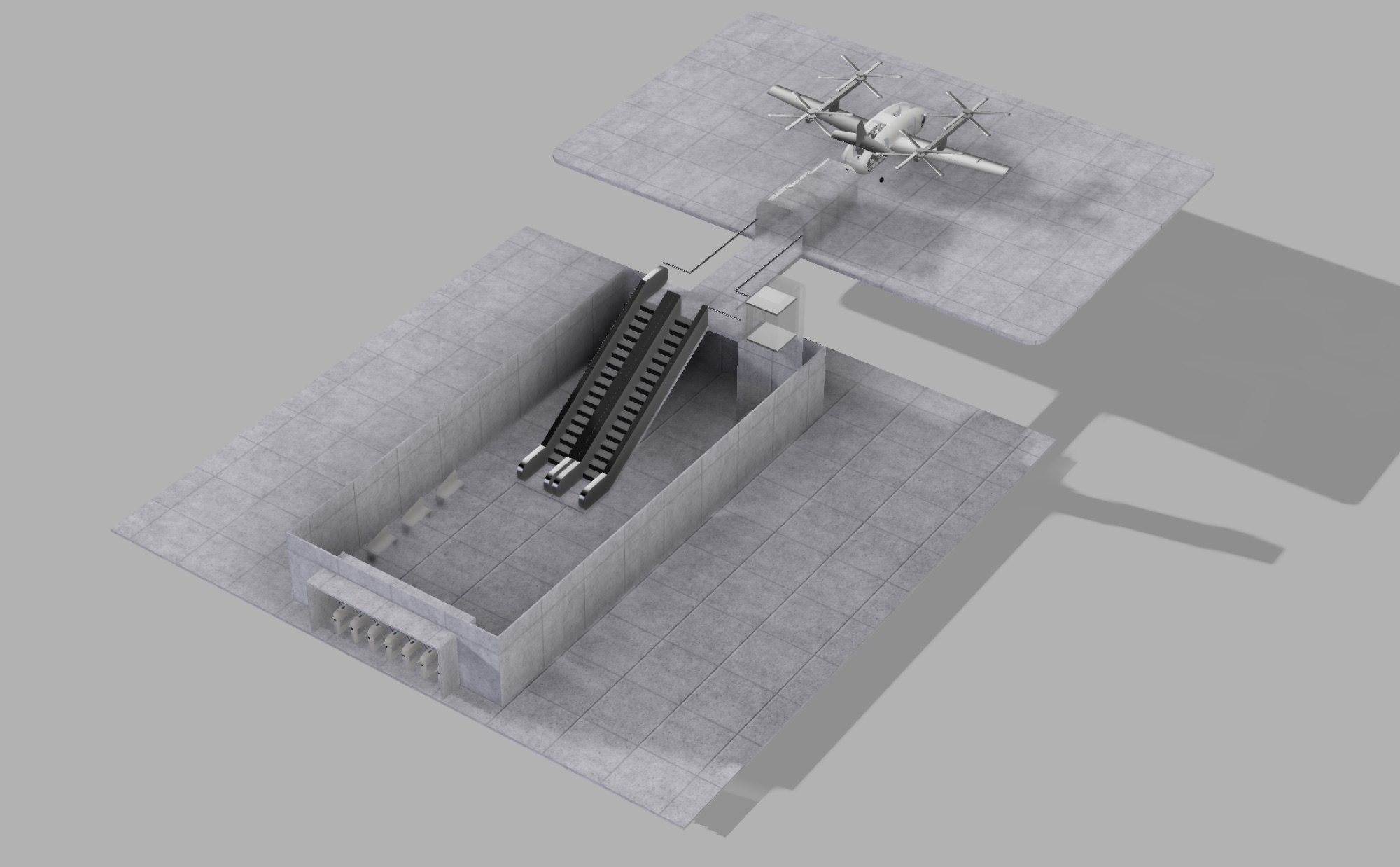
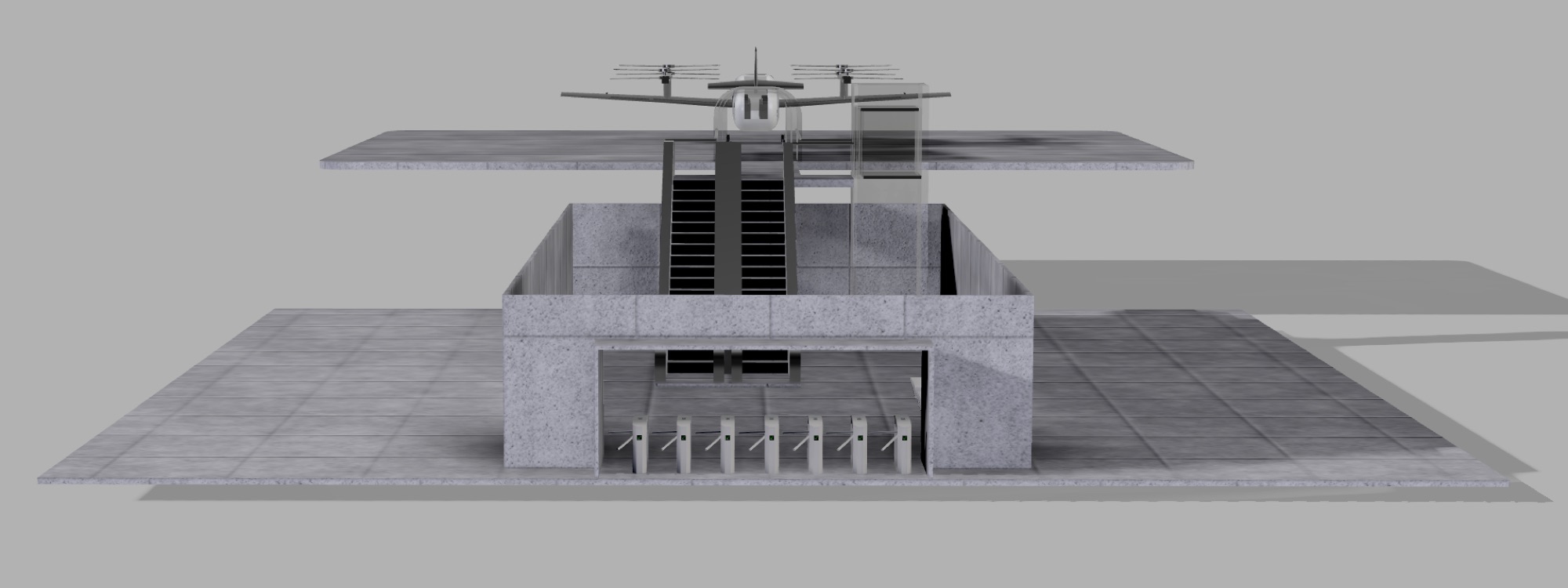
Street to roof pad, by lift
Face scan — 30 s
Both borders at once — 4 min
Gate closes T-5, walk on
- Boarding bridge, not tarmac. Nobody goes near a spinning rotor.
- Aircraft speed, metro simplicity. No check-in desk, gates 60 seconds apart.
- Cleared once. On arrival you simply walk out.
What one trip feels like
Shekou → Sheung Wan, Hong Kong
Total 39 minof which airborne 13 min
To the vertiport
Face scan + screening
Border — cleared once
Gate hold
Airborne · 250 km/h
Released on arrival
To your destination
Why you don't arrive two hours early
Whitelist membership plus an online declaration 60 minutes before departure pushes every document to both sides in advance. On site it is a face scan, 30 seconds a person. The gate closes 5 minutes before departure — arriving 20 minutes ahead is plenty.
Why you don't queue again on landing
Cross-border lines use co-located clearance — both jurisdictions check you once, at the departure end. If you had to queue again on arrival, the hour saved in the air would be handed straight back in the arrivals hall.
Turnaround
Ten minutes on the ground
Every line flies point to point with no intermediate stops, so only the terminus needs a turn. This is what happens in those ten minutes.
01
1min
Shut down, rotors spin down
Doors safed
02
2min
Deboard
12 people, aft ramp
03
6min
Robotic battery swap
Runs in parallel
04
2.5min
Board
Already queued inside the gate
05
2.5min
Doors close, self-test
Request departure
The steps sum to 14 minutes, but the swap overlaps boarding, so the real turn is 10. On most lines one charge covers the round trip — those turns take 6.
Scheduled departures — nobody waits for the seats to fill
| Timetable | Trunk · L1 / L3 / L5 | Core · L2 / L4 / L6 / L7 | Branch · L8 / L9 |
|---|---|---|---|
| First wave 06:30–07:00 | 20min | 30min | 40min |
| AM peak 07:00–09:30 | 10min | 15min | 20min |
| Midday 09:30–17:00 | 20min | 30min | 40min |
| PM peak 17:00–20:00 | 10min | 15min | 20min |
| Evening 20:00–23:00 | 20min | 30min | 40min |
Cross-border lines run to 22:30 (limited by border-post staffing); domestic lines to 23:00. 886 departures a day across the network, flown by a fleet of 44.
Cost and fares
“How can a flight cost about the same as a taxi?”
The answer is not that the aircraft is cheap. It is that one aircraft carries twelve people, and it flies in a straight line.
Vertiport and ground
¥720
Depreciation, rent, landing fees, station staff, screening
Maintenance and spares
¥534
At ¥2,000 per flight hour
Insurance, ATC, ops control, admin
¥505
Includes amortised cross-border systems integration
Aircraft depreciation
¥292
¥30 M each, over 15 years
Contingency and reserve
¥270
Cancellations, ramp-up subsidy
Pilot
¥227
One pilot plus remote supervision
Electricity
¥127
159 kWh × ¥0.8
Battery depreciation
¥60
Pack replaced roughly every 4 years
Total
¥2,735
Cost per departure
¥2,735
Passengers per departure
8.4
12 seats × 70% load
Cost per passenger
≈ ¥326
A 12-seat aircraft burns about ¥10,500 an hour; a ride-hail car about ¥60 — 170× more expensive. But it is four times faster and carries twelve people, so the cost per passenger-kilometre lands at roughly 1.6× a taxi. Add the straight line — 50 km flown against 65 km driven — and the whole trip comes out about 20 % above a taxi.